

19/06/26
Jun 2026 | Workshop/ Session
Route to Roots
Bridging Learning Gaps through Conceptual Continuity
Facilitated by Mr. Sandeep Sethi Grades 1–12 Mathematics
Date : 22nd -23rd May, 2026
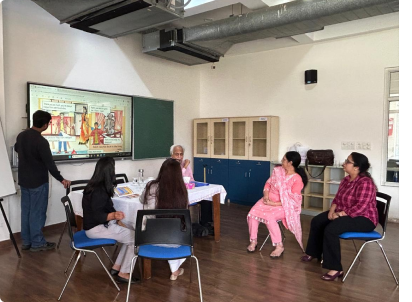
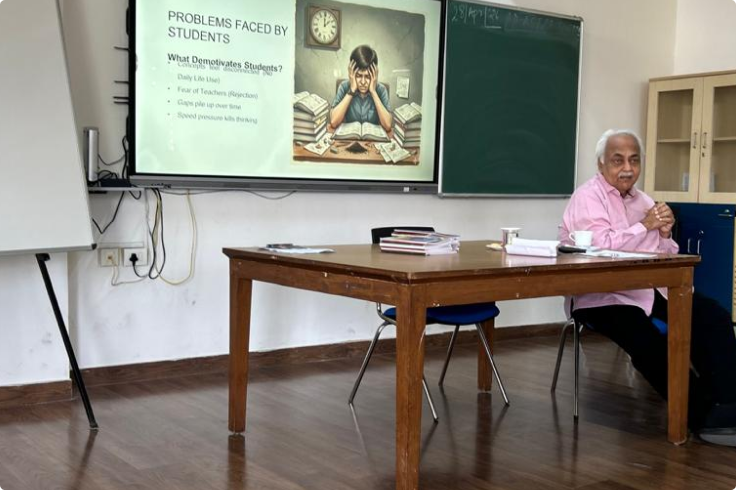
Mathematics teachers from Grades 1 through 12 came together for what turned out to be an exceptionally enriching professional development session. The workshop, aptly titled Route to Roots, was facilitated by Mr. Sandeep Sethi — a visionary in the field of education who has long championed the cause of meaningful, transformative teaching.
Day 1: The Core Idea: Going Back to Go Forward
At the heart of the workshop was a deceptively simple but powerful idea: that the most effective way to address a learning gap is not always to push forward, but to go back — to the root.
Every mathematical concept taught in school is part of a continuous chain. What a child first encounters as a simple pattern in the early grades quietly evolves into a far more complex and advanced concepts by the time they reach higher grades. When there is a break in that chain — a gap in understanding — the effects ripple forward, making each subsequent concept harder to grasp.
The problem is best addressed by going a step back towards the root of the concept. A simple tool of multiple worksheets can be used to achieve the objective. In a way, you find that the worksheets are connected, through the invisible bond of the root concept. Therefore, basis the child’s need, the worksheets can be assigned.
For e.g. Patterns in numbers in Grade 3,4 can be used ahead in Grade 5 as shapes or playing with numbers in Grade 7,8 to AP, GP in Grade 9,10 to Sequence and Series in Grade 11,12. What appears to be a collection of separate exercises is, in fact, a connected set — bound together by that invisible thread of the underlying concept.
Day 2 : Graphic Novels in Mathematics Instruction
The session highlighted the growing importance of graphic novels as an effective teaching and learning tool in mathematics education. Participants explored how graphic novels can make mathematical concepts more engaging, accessible, and meaningful for students across different grade levels.
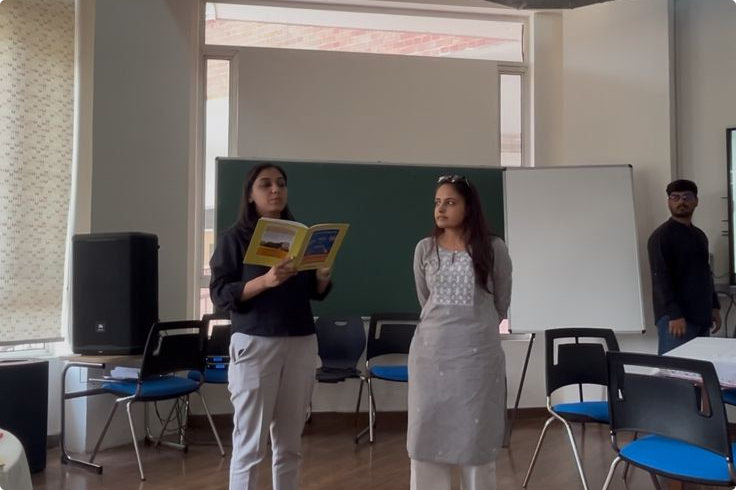
As part of an interactive activity, teachers were divided into groups and invited to select a graphic novel of their choice from any topic and grade level. Each group was tasked with enacting and presenting the storyline of the chosen graphic novel to their peers. This collaborative exercise enabled teachers to experience firsthand how visual narratives can enhance comprehension, stimulate creativity, and promote active participation in the classroom.
The activity encouraged educators to reflect on the pedagogical value of graphic novels and consider their integration into teaching practices to support student engagement and deeper understanding of concepts.
Role of Mathematics Teachers
The workshop also turned its gaze to the broader role that mathematics teachers play in a student’s life. Mathematics, when taught well, is not merely an academic subject — it is a life skill. It sharpens reasoning, builds problem-solving habits, and equips young people to navigate the world with greater confidence and clarity. This is why the teacher’s role in a mixed-ability classroom is so critical. Not every child arrives at the same place, and not every child learns at the same pace. The ability to identify where each student stands and to respond thoughtfully — without leaving others behind — is one of the most demanding and most important skills a teacher can develop.